What makes these books different

Three things your child gets from every story.

Most early readers teach reading. These also teach the words of the school year and how to handle the small, real situations of growing up, and they can be written around your own child.

1

School words and subjects, built into each grade’s stories

Every grade, from Kindergarten to Grade 6, covers the same ten subject areas, and each area goes deeper as your child moves up. Each book takes one subject for that grade and is written around its vocabulary, so the words come up naturally in a story your child cares about.

  • Ten subject areas in every grade: government and citizenship, character, life science, point of view, technology and society, theme, history and culture, earth science, economics, physical science.
  • About 1,760 school words across the seven grades, between 193 and 339 in each grade.
  • Every chapter opens with its new words and their meanings.
  • Science and social studies words are marked with a star.
  • Your child can tap any word in the story to hear it.

Kindergarten, Grade 1, Grade 2, Grade 3, Grade 4, Grade 5 and Grade 6 are ready to read.

How one subject grows: Life Science

  1. KindergartenPlants and Animals Have Needs
  2. Grade 1Plants and Animals Grow and Change
  3. Grade 2Plants and Animals in Their Habitats
  4. Grade 3Animal Adaptations
  5. Grade 4Observing Nature
  6. Grade 5Cultivating Natural Resources
  7. Grade 6Relationships in Nature

Example: words from The Bean That Wouldn’t Grow (Kindergarten)

  • bloomed ★opened up into flowers
  • vines ★long plants that climb
  • ripe ★ready to pick and eat
  • fertile ★good for growing plants
2

Life stories that teach what to do and how to handle feelings

Every book puts Parker in a situation your child will meet too. The story shows what she feels, what she tries, and what works, so your child has an example to go back to when it happens to them.

  • One clear lesson per book, named on its page.
  • Naming a feeling comes first, then what to do about it.
  • A question after each chapter, with feelings to pick and space to draw.
  • Harder subjects are added gently as the grades go up.

Some of the lessons

3New

A one-of-a-kind book, written around your own child

You can make your child the main character. We do not just swap in a name: the story is written around what you tell us about your child, so no two families get the same book. The school words and the lesson of each book stay.

  • Their name on the cover, and an avatar with their skin tone, hair, glasses and clothes in every picture.
  • Their family and their real friends in the story, by first name.
  • Their family’s culture: what they call Grandma, the foods on their table, the holidays they keep.
  • Real words from their home language in every book, in its own script, to tap and hear.
  • Matched to their grade, and growing with them from one grade to the next.

[Your child] Figures It Out

Make a book for your child

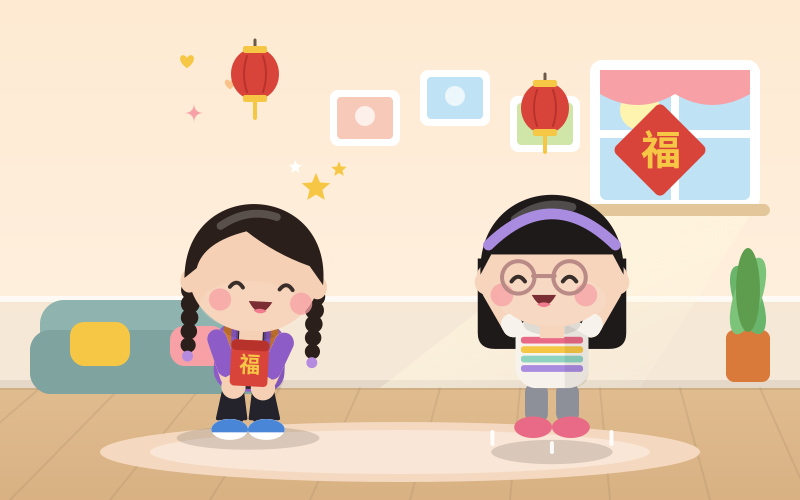
Cover art from Red Envelopes and Thank-Yous

Reading together

A few tips for parents and teachers.

  • Use a tablet if you can, with the sound on. A phone or computer also works.
  • Look at the Words to Know together before each chapter.
  • Let your child tap words on their own. Hearing a word again is part of learning it.
  • Stop at the Talk About It question and let your child answer in their own words.

See it in a story, then make it your child’s.